Researchers, staff and students from the RNCM shared their work on music, movement and embodied practice at the 19th International Eurhythmics Symposium, Vicinities of Music and Movement, held at the Hochschule für Musik Dresden, Germany, from 17-20 September 2026.
The symposium brought together an international community of educators, researchers and practitioners to explore the relationship between music, movement and learning. Among those representing Research at the RNCM were John Habron-James (Professor in Music and Head of Music, Health and Wellbeing), and Bethan Habron-James (Dalcroze Eurhythmics Tutor), who contributed a series of presentations and workshops highlighting both historical and contemporary perspectives on eurhythmics.
Together with Selma Landen Odom (Professor Emerita, York University, Toronto), who joined remotely from Canada, they presented a workshop examining the First Congress of Rhythm, held in Geneva in 1926. Drawing on research spanning microhistory, Dalcroze pedagogy, disability studies, neuroscience and psychotherapy, the session brought to life the people, ideas and debates that shaped this significant moment in eurhythmics history. Participants also explored practical movement activities based on exercises discussed at the original congress a century ago.
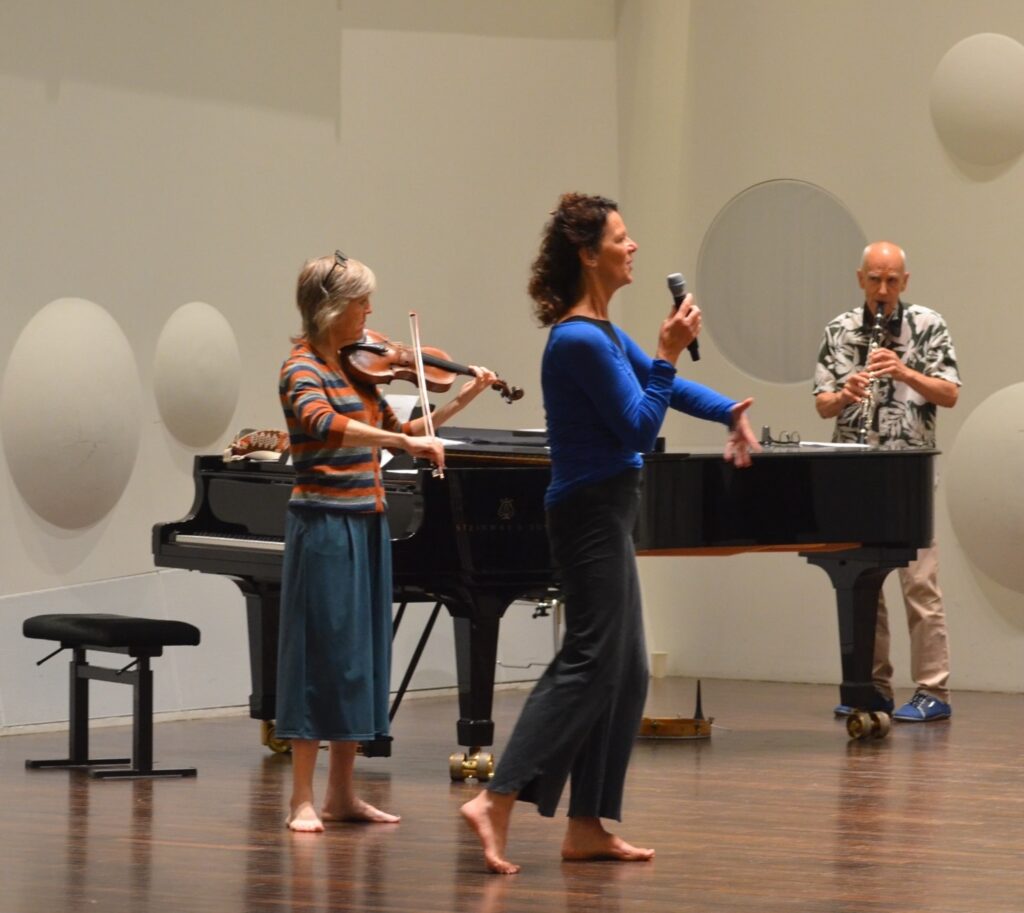
Bethan Habron-James also collaborated with colleagues from Germany (Professor Elisabeth Pelz, Hamburg University of Music and Drama) and Switzerland (Fabian Bautz, University of Lucerne) on a workshop entitled An Exchange Between Contemporary Score and Listening Body. The session invited participants into an improvisatory process of responding to instrumental and vocal sounds through movement, exploring the connections between listening, the body, and creative expression. The workshop featured Ancient Song, a new composition by second-year BMus Composition student Thomasine O’Sullivan, written especially for the event. The piece acted as both inspiration and a springboard for the creation of collaborative responses through music-making and performance.
Reflecting on the experience, Thomasine said:
“[The experience was] revelatory in the sense that the short and somewhat limited piece that I had written was transfigured into three uniquely differing explorations of body, expression and choreography that flourished with many interwoven layers.”
In a further presentation, John Habron-James joined Dorothea Weise (Professor, Berlin Hochschule für Musik) and Marianne Steffen-Wittek (Professor Emerita, University of Music Franz Liszt Weimar) to share research from a forthcoming chapter in the Routledge Companion to Dance and Somatic Practices, due for publication in 2027. The chapter traces connections between early Dalcroze practice and the development of body awareness methods, dance, music therapy and special music education.
Organised by Christine Straumer, the symposium also marked the 25th anniversary of the Institut Rhythmik Hellerau and the 50th anniversary of the Fédération Internationale des Enseignants de Rythmique, celebrating the continued international influence of eurhythmics across education, research and artistic practice.