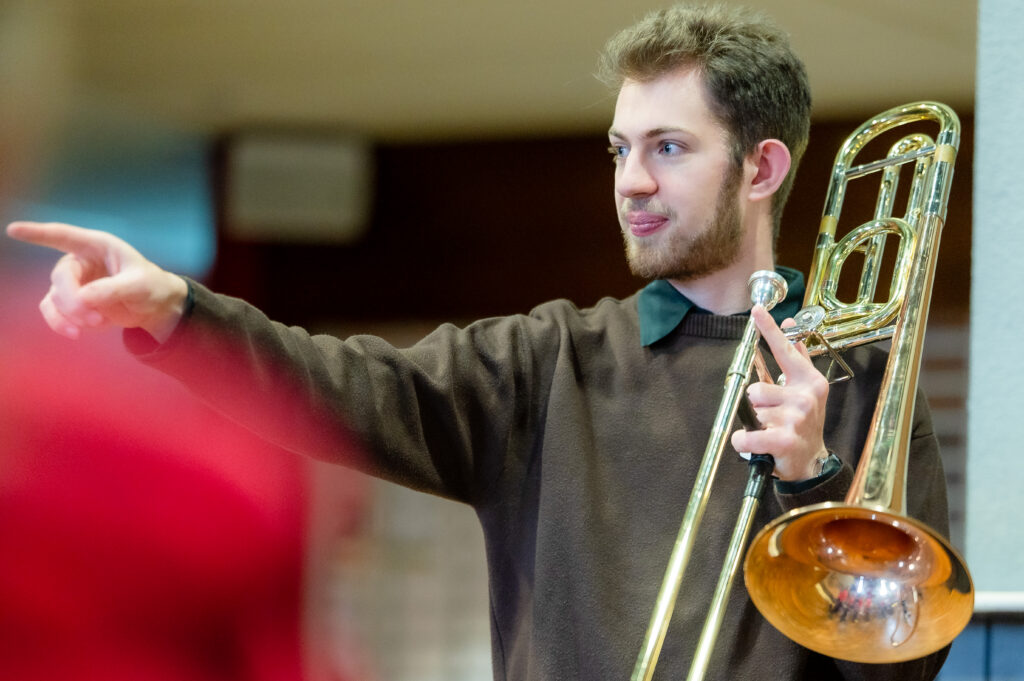
Master of Education
The highly specialised Master of Education (MEd) is designed for music teaching professionals who wish to gain further training and accreditation for their teaching and/or conducting practice.
It is also ideal for musicians who have completed an undergraduate or postgraduate course at university or conservatoire and are now looking to develop a specialist career in education.
Rooted in both theory and practice, the programme encourages students to engage critically with current educational thinking, undertake independent research, and apply their learning in real-world contexts. Graduates leave with enhanced knowledge, practical skills, and the confidence to contribute meaningfully to music education in a wide range of settings.
Alongside the MEd, this programme offers two other potential exit awards: a Postgraduate Diploma (120 credits) and a Postgraduate Certificate (90 credits).
Key Information
- Duration
- 1 year full time or 2 years part time
- Credits
- 180
- Course Code
- 901F 1 year; 902P 2 years
- Application Opens
- 9 Jul 2026
- Application Deadline
- 13 Jan 2027
- Fees
- Fee guide
Entry Requirements
Qualifications and Standards
All MEd applicants are expected to hold a Bachelor’s degree or equivalent (FHEQ Level 6), normally in music. If your qualification is not in music, you will need to satisfy the RNCM, at interview, that you have the necessary musical background and demonstrate potential to successfully complete the programme.
An IELTS score of 6.5 (with no less than 5.5 in each component) is required for applicants who are not from a majority English-speaking country (as defined by UKVI), with exceptions being at the discretion of the admissions panel. If you are continuing from previous RNCM programmes, no further IELTS will be required, and your ability would be assessed at interview.
Supporting Documents
Once you have completed your UCAS Conservatoires application, you need to submit your portfolio of work via Acceptd. This should include:
- A five-minute recording of your teaching, taken from a larger activity, lesson or rehearsal.
- Permission forms for every person featured in the recording. A permission form template will be provided by the RNCM Admissions team once we have received your UCAS application. If it is not possible to submit a video or gain consent, applicants should submit an alternative piece of evidence that highlights their good pedagogical practise, such as a set of lesson plans or a musical resource they have created.
- A 1000-word sample of writing, normally on music (which may be an excerpt from an existing piece of work you have written), using references, is required if your undergraduate degree was not undertaken at the RNCM.
UK applicants may be required to undertake an Enhanced DBS (Disclosure and Barring Service) Check to participate in some professional placement modules within this course. Applicants from countries other than the UK, or UK residents who have spent six months or more in any non-UK country within five years of the course start date must additionally provide a police certificate of good conduct from the relevant country.
Programme Details
The degree requires the completion of 180 credits and includes four compulsory modules: Music Education: Philosophy, Theory and Practice; Research Methods: Music Education RMME; Dissertation; and Placement.
Alongside the MEd, this programme offers two other potential exit awards:
Postgraduate Diploma: 120 credits, including completion of the Music Education: Philosophy, Theory and Practice, and Placement modules.
Postgraduate Certificate: 90 credits, including completion of the Music Education: Philosophy, Theory and Practice, or Conducting module.
Overview
Master of Education or Postgraduate Diploma in Education or Community Conducting
The MEd and PG Dip programmes enable you to:
- Develop knowledge of a range of relevant and current educational concepts as it informs your own practice as educators and/or community conductors.
- Demonstrate critical and ongoing reflection of your own practice as educators.
- Creatively respond to ever-changing developments in pedagogy and music education through innovation, adaptability, flexible approaches to your practice, and supportive, inspiring leadership and collaboration.
- Promote healthy and holistic approaches to learning and teaching informed by principles of social justice, equality, diversity and inclusion.
- Become an educator with the ability to work in complex musical situations and respond to complex and diverse issues proactively and creatively.
On successful completion of the programme students will be able to:
Knowledge and Understanding
- Demonstrate systematic understanding of current practices relevant to your own teaching and/or conducting.
- Demonstrate sophisticated, original, and thoughtful pedagogical concepts in your teaching and/or conducting.
- Demonstrate expert theoretical skills and the ability to put them into practice, with the ability.
- To critically reflect on these through healthy approaches to teaching and learning
- Demonstrate critical engagement with a comprehensive knowledge of the concepts relevant to your area of teaching and/or conducting.
- Demonstrate originality in your development of knowledge and understanding of pedagogical concepts through research.
Specialist Subject Skills
- Demonstrate flexible and responsive leadership in a variety of teaching and learning activities.
- Reflect on, develop, and refine your teaching and/or conducting practice.
- Critique, evaluate and apply research methodologies in your practice.
- Disseminate the knowledge of and insights into your practice fluently and concisely to the widest range of audiences at an appropriately inclusive level.
- Demonstrate innovation, entrepreneurship, flexibility and resilience in drawing on a range of relevant pedagogical techniques and/or research methods applicable to your practice.
Generic and Graduate Skills
- Assimilate and synthesise current research and practice as it relates to your own field, deploying it theoretically and/or applying it within the relevant discipline.
- Command a range of relevant research and dissemination tools, employing appropriate media and technologies.
- Plan, research and realise individual projects at an advanced level, harnessing independent learning skills for personal career development.
Postgraduate Certificate in Education or Community Conducting
The PGCert enables you to:
- Demonstrate critical and ongoing reflection of your own practice as educators.
- Creatively respond to ever-changing developments in pedagogy and music education through innovation, adaptability, flexible approaches to your practice, and supportive, inspiring leadership and collaboration.
- Promote healthy and holistic approaches to learning and teaching informed by principles of social justice, equality, diversity and inclusion.
- Become an educator with the ability to work in complex musical situations and respond to complex and diverse issues proactively and creatively.
On successful completion of the programme students will be able to:
Knowledge and Understanding
- Demonstrate critical and ongoing reflection of your own practice as educators.
- Creatively respond to ever-changing developments in pedagogy and music education through innovation, adaptability, flexible approaches to your practice, and supportive, inspiring leadership and collaboration.
- Promote healthy and holistic approaches to learning and teaching informed by principles of social justice, equality, diversity and inclusion.
- Become an educator with the ability to work in complex musical situations and respond to complex and diverse issues proactively and creatively.
Specialist Subject Skills
- Demonstrate flexible, adaptive and responsive leadership in a variety of practical activities
- reflect on, develop, and refine your pedagogical and/or conducting practice.
- Disseminate the knowledge of and insights into your practice fluently and concisely to the widest range of audiences at an appropriately inclusive level.
- Demonstrate innovation, entrepreneurship, flexibility and resilience in drawing on a range of relevant pedagogical techniques applicable to your practice.
Generic and Graduate Skills
- Assimilate and synthesise current relevant practical concepts as they relate to your own field, deploying it theoretically and/or applying it within the relevant discipline.
- Command a range of relevant practical and pedagogical tools, employing appropriate media and technologies.
- Plan, research and realise individual projects at an advanced level, harnessing independent learning skills for personal career development.
Module Map
- Music Education: Philosophy, Theory and Practice (30 credits)
- Research Methods: Music Education (30 credits)
- Dissertation (Minor 30 credits/Major 60 credits)
If undertaking a Minor Dissertation, the credits will be completed by taking one optional module (30 credits) from the optional modules available. - Placement (60 credits)
Year 1
- Music Education: Philosophy, Theory and Practice MEPTP (30 credits)
- Research Methods: Music Education RMME (30 credits)
Year 2
- Dissertation (Minor 30 credits/Major 60 credits)
If undertaking a Minor Dissertation, the credits will be completed by taking one optional module (30 credits) from the optional modules available.
Years 1 and/or 2
- Placement (60 credits)
The placement can run over both years if preferred.
In addition to the compulsory modules outlined, you can elect one 30-credit elective from most other modules from the Graduate School suite of programmes. The following mix of practical, research, and vocational modules may be taken:
Accompaniment
This module, not available to Principal Study Accompanists, offers regular performance opportunities and feedback. Content includes duo sonatas, song, orchestral reductions, and opera, with techniques for working in varied duo partnerships. Assessment is by practical test.
Arrangement
Open to all students upon successful application, this module provides tuition in arranging works for designated ensembles. Students may have their work performed or recorded by inhouse ensembles. Assessment is by portfolio with commentary.
Composition Elective
Open to all except Principal Study Composers. Entry is via submission of previous work. Tuition develops technical, interpretative, and communication skills. Assessment is by portfolio.
Conducting Elective
This module develops clear and effective conducting technique. Assessment includes a selfevaluation exercise, practical portfolio, and a final class performance.
Contemporary Songwriting
This module provides tools and strategies to build a continually developing songwriting and composition toolkit, using both conventional and unconventional approaches.
Cross-cultural Approaches to Musicianship
This module examines how different musical traditions, practices, and ways of learning across cultures shape our understanding and development of musicianship.
Dalcroze Eurhythmics and Dynamic Rehearsal
This practical course explores how music is experienced and expressed physically through movement. Students engage in technical, expressive, and creative work, with opportunities to apply these skills to repertoire. Assessment includes practical exercises and a written portfolio.
Dalcroze in Context
This module explores these ideas within the field of Dalcroze studies, connecting them to music education, music therapy and music psychology, amongst other fields. Students will engage with a wide range of concepts, methods, and texts, and carry out a student-led research project into an aspect of Dalcroze practice, theory, or history.
Electronic Experimental Ensemble
This ensemble combines poptrained and classically trained musicians to explore 21stcentury chamber performance practices. Through a collaborative workshop environment, students investigate influential movements such as Wandelweiser, Japanese noise, postfree improvisation, and the European avantgarde. Assessment includes group performance and individual viva voce.
Freelance Musician
This module builds entrepreneurial skills for a portfolio career. Workshops cover musicianship, programming, marketing, recording, business planning, and outreach project development. Assessment is via video project submission and viva voce.
Music and Environment
This module explores how musical creativity, sound, and listening relate to ecological themes, environmental issues, and our changing natural world.
Musicianship for Vocalists: Consort Singing
This module develops consortsinging techniques across a range of styles, from early polyphony to contemporary repertoire. Students may apply as preformed groups or individually. Assessment is through a group performance featuring prepared repertoire and quickstudy elements.
Practical Pedagogy
This module equips students with practical skills for teaching musicians of varying abilities, including musical observation, reflection, and communication. Delivered in partnership with the local education service, it includes placement opportunities. Assessment is by portfolio (including video documentation) and viva voce.
Professional Audition
This module provides advanced training for professional auditions, addressing repertoire preparation, advanced reading skills, stylistic expectations, interpretation, and the psychological demands of auditioning. Assessment is by portfolio and viva voce.
Professional Placement
Students undertake mentored work experience in contexts such as orchestral professional experience schemes, arts administration, music and health, or recording. Placements can be individually negotiated. Existing partnerships include the Hallé, BBC Philharmonic, Manchester Camerata, and RNCM departments. Assessment is by portfolio.
Repertoire Project
This module supports development of a final recital or portfolio by guiding students through writing a professionalquality programme note and engaging with relevant scholarship. Assessment is by written work.
Research Lecture Recital
This module offers an in-depth exploration of the necessary skills for delivering an original lecture recital. Students are encouraged to pursue topics relevant to them as performers and composers, with practical emphasis on a range of delivery styles, supporting materials, and techniques of public speaking. Assessment is by 30-minute lecture recital and annotated bibliography (1,000 words).
Small Ensemble Performance
(Chamber Music / Small Jazz Ensemble / Historical Performance Ensemble)
This module develops the skills, repertoire knowledge, and ensemble techniques essential for professionallevel smallensemble performance. It includes ensemble coaching, focused classes, workshops, and intensive private study. Assessment is through performance and a written rationale.
Underrepresented Music and Musicians
This module explores the voices, traditions, and creative contributions of musicians and musical cultures that have been historically marginalised or overlooked, examining their impact and significance within a broader musical landscape.
Your Application
Applications for most RNCM programmes open in July and should be submitted using UCAS Conservatoires and Acceptd. The application process includes a number of stages, including an audition and interview.
Professors and Lecturers
-

Jennie Henley
Director of Programmes
-
David Horne
Professor in Composition and Head of Graduate School
-
Robert Gardiner
Senior Lecturer in Music Education and Programme Lead Music Education (PGCE)
-
John Habron-James
Head of Music, Health and Wellbeing
-

Simon Clarke
Senior Lecturer in Philosophy and Music and Deputy Head of Graduate School
-

Mark Heron
Professor and Head of Conducting
-

Stuart Overington
Director of RNCM Chamber Choir and Symphony Chorus
‘Our Master of Education degree is an innovative programme that has been deliberately designed to support the varied and flexible professional lives of music educators, aiming to nurture and support teachers across all disciplines, musical styles, contexts and settings.’
Programme Lead for Music Education
Additional Information
Accommodation
All applicants who accept a guaranteed offer before 9 February will be reserved a room in Sir Charles Groves Hall of Residence, which they will be invited to book in the months following their audition. Private en-suite rooms are grouped in clusters of four with shared kitchen facilities.
Scholarships and Bursaries
All applicants are automatically considered for a scholarship, and these are awarded based on performance ability and potential demonstrated at audition and interview. Scholarship awards are for the first year of study only (unless specifically stated otherwise).
A limited number of bursaries are also available for International and postgraduate students, allocated based on need and merit. If you’re successful in gaining a bursary, this will be deducted from your tuition fees, leaving you with a net balance to pay.
Undergraduate home students may apply for an Access Bursary if their income meets the published criteria. To apply for an Undergraduate Access Bursary, please contact Student Finance England (or the relevant local authority for your country). You need to apply as an income assessed student and you and your sponsors (usually your parents) need to consent to share their household income with the RNCM.
Tuition Fees
Tuition fees are split into two categories – home and international. Your fee status will be determined by the information provided within your UCAS Conservatoires application. Full guidance on tuition fee statuses can be found on the UKCISA (UK Council for International Student Affairs) website, but if you have any queries or think you have been assigned an incorrect status, please email [email protected] and we would be happy to undertake a full fee assessment with you.