Postgraduate Conducting
On our Master of Music (MMus) programme you’ll receive unrivalled opportunities to develop your craft and prepare for a career.
You will pursue conducting as your Principal Study through this degree, but please note that the one-year intensive option isn’t available for this discipline; all students follow the two-year route.
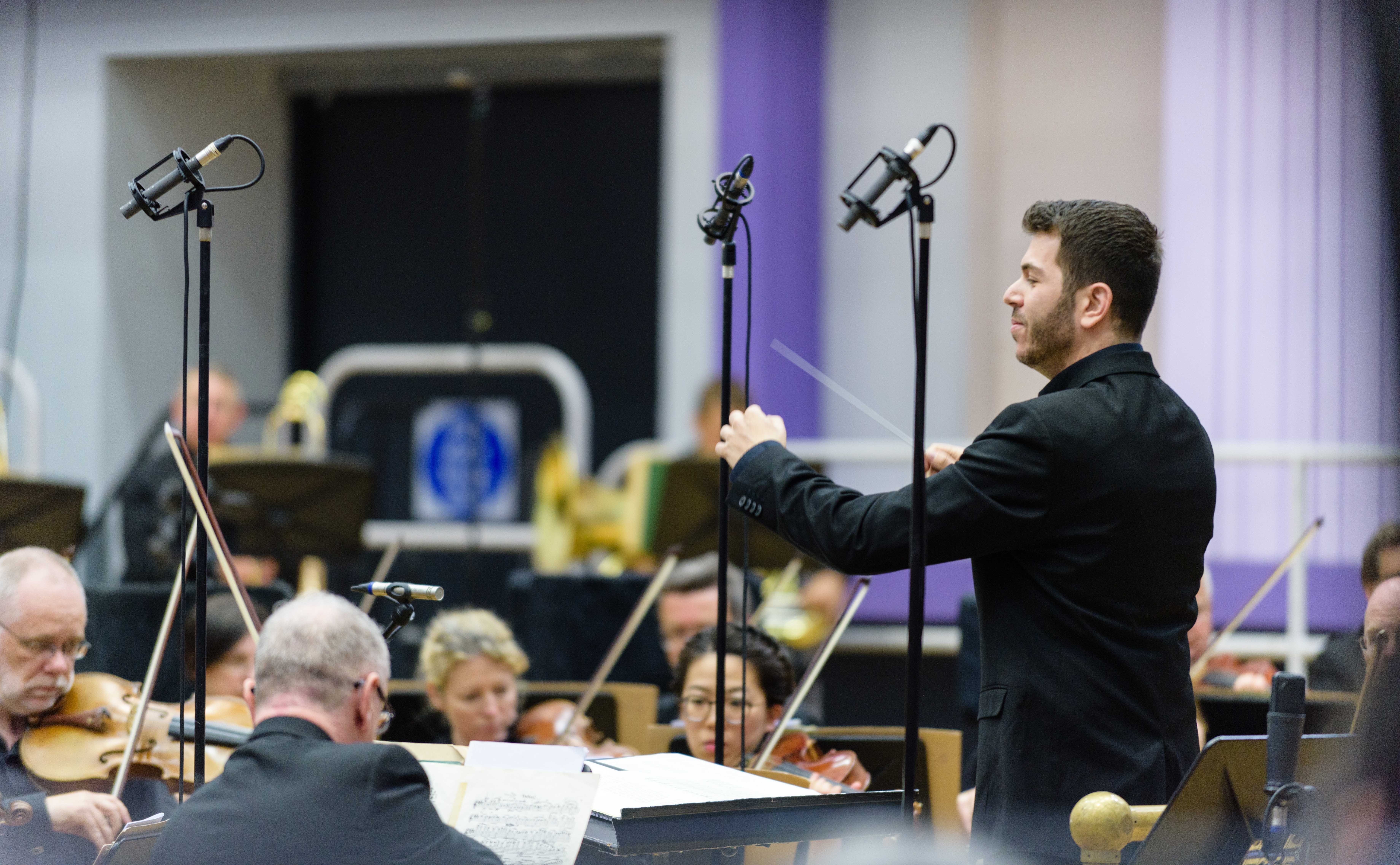
We generally admit five students per year as orchestral conductors, and two per year as choral conductors.
Tuition
As an MMus orchestral student, you’ll study jointly with Professor Mark Heron, Head of Conducting, and Professor Clark Rundell. Nicolás Pasquet, and David Hill make several teaching visits each year, and other recent guests have included Marin Alsop, Anja Bihlmaier, Alexandre Bloch, Alpesh Chauhan, Sir Mark Elder, Ed Gardner, Antony Hermus, Gergely Madaras, Ludovic Morlot, Nicolás Pasquet, Vasily Petrenko, John Storgårds, Mark Wigglesworth, and Simone Young. Choral conductors study with Stuart Overington and receive regular guidance from David Hill. As well as working extensively with our Chamber Choir and Symphony Chorus, choral conductors also have the opportunity to develop their skills with orchestras and other instrumental ensembles through participation in the orchestral classes.
In classes, orchestral sessions, rehearsals, and performance projects, you’ll have regular contact with many RNCM faculty members and professional orchestral musicians. This includes a plethora of experienced orchestral leaders and principal players with decades of experience in orchestras such as the BBC Philharmonic, City of Birmingham Symphony Orchestra, Hallé, Royal Liverpool Philharmonic, Royal Philharmonic, Manchester Camerata, Opera North and others. Historical performance expert Harvey Davies and contemporary piano specialist Benjamin Powell each have more than 20 years’ experience of playing for our classes.
Most of the tuition is class-based with twice-weekly sessions working with highly experienced professional pianists or small instrumental ensembles and regular ensemble and orchestral sessions, both internal and external, devoted to the study of repertoire and development of rehearsal technique. One-to-one lessons are shared between the faculty and visiting teachers, ensuring the widest variety of input.
Performance
Podium opportunities are many and varied with all students playing a significant part in the RNCM’s strong performance culture. You will work with our orchestras, new music ensembles, wind and brass bands, choirs, and opera scene performances. Selected students will have the opportunity to work as assistant conductors on RNCM Opera productions, including conducting a performance. Our close connections with local orchestras and choirs mean concert placements during the first year of study, and the opportunity for paid engagements in the second year.
Professional Partnerships
Students serve as assistant conductors to the BBC Philharmonic and Royal Liverpool Philharmonic orchestras and can expect to have at least five or six week-long assistantships per year. Choral conductors have similar opportunities to observe or assist with the Hallé Choir, Royal Liverpool Philharmonic Choir, Kantos, Huddersfield Choral, and others. Orchestral student have the opportunity to conduct the Hallé in a masterclass, and will work with NEW sinfonia. Choral students have a masterclass with the Bach Choir.
Mills Williams Scholars
We are very grateful to the Mills Williams Foundation for their support of scholarships which are awarded on merit to selected second year students.
Career Development
The process of preparing you to start your career begins the moment you walk through the door. In our business, two years is no time at all, and we regard helping you to plan the next stage in your journey as a vital part of our role. As well as being mentored by our team, who have active performing careers alongside their teaching work, you’ll have regular contact with a wide range of industry professionals including agents, artistic planning professionals, orchestral managers, outreach specialists, producers, and many more.
There is no such thing as a typical RNCM Conducting graduate – something we are immensely proud of! When you graduate you may immediately have a career with major orchestras; you could be working in opera or ballet; a career in contemporary music may beckon; choral conducting may be your thing; maybe you’ll specialise in education, outreach and diversity projects; your focus could be wind or brass bands in the Military or non-professional fields; a career as a conductor and teacher in higher education, or many other possibilities.
A major focus of your time with us will be identifying and planning for the sort of career that suits you and your skillset.
Examination
Currently, Master’s students take their final examination in concert with the BBC Philharmonic, or another professional ensemble or choir.
You may wish to note that our application cycle is earlier than in many countries. The closing date for application is early October in the year preceding entry, and auditions usually take place in March.
Read the audition requirements.