
Interview with Louise Wallwein
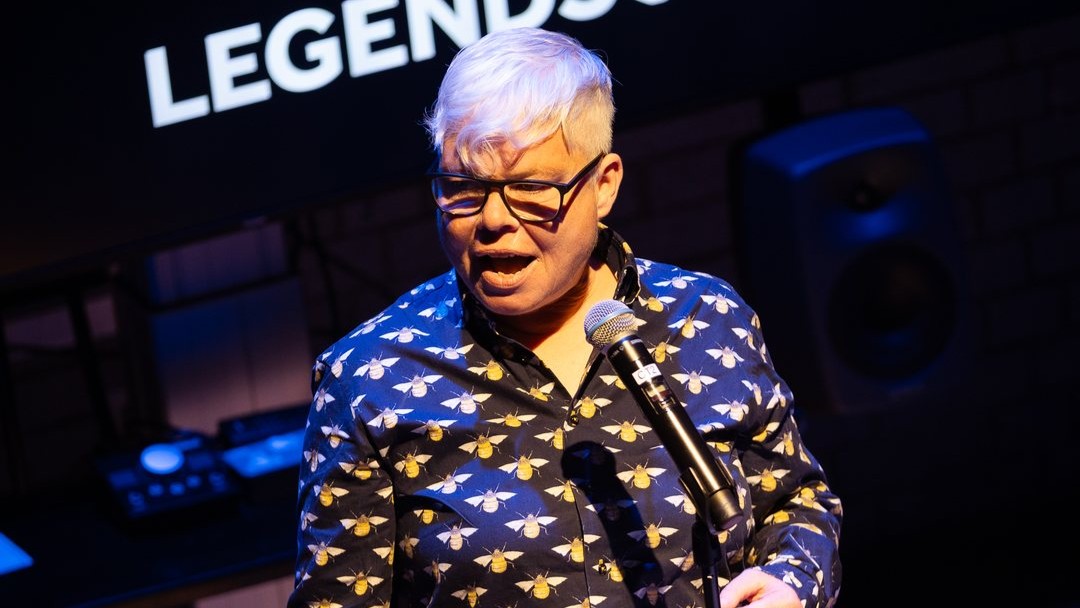
©Robin Clewley
By Sarah Walters, PR and Communications Manager
Louise Wallwein MBE is a multiple award-winning poet, playwright, and performer from Manchester whose companion plays, Melting Ice (1998) and Glue (2016), have earned her international acclaim for their candid accounts of life in the care system and Louise’s successful search for her birth mother. Louise comes to the RNCM in March to perform an original spoken word commission alongside the RNCM Symphony Orchestra, inspired by the theme of Legends and Lore and Nikolai Rimsky-Korsakov’s Scheherazade suite based on the famous folktales One Thousand and One Nights (aka The Arabian Nights).
Q: You are the RNCM’s first Poet-in-Residence; what do you hope the experience and benefits of joining the College will be for you and for RNCM musicians?
Louise: I feel very proud. I was working with some students the other day, and what I was saying to make them feel comfortable is that I wanted them to know that the respect is already there. I have huge respect for the work of the students at the RNCM because I recognise how hard they must have worked all their lives to get to where they are.
I met with some students working on the Spotlights sessions and they’re so gifted. I’m quite in awe of them. I’m not sure if I’m supposed to be, but I just am! I see them very much as artists and pioneers, but what they were telling me is that throughout most of their careers they expect to be doing the work that they’re told to do. So, this is an exciting opportunity to really experiment; they were really open to some of my wild ideas, and also really very clear if my ideas weren’t landing as well. They know what they want, and that made it such a pleasure for me. Often when I’m working in the community, most of my job is getting people to write or getting people to think creatively, but that work is already done with these students.
I was just so overwhelmed to hear them sing, play their instruments, and to see these perfectly formed artists. And at the same time, I’m hoping to be a bit disruptive of what they would normally do, to challenge their ideas as well. They seem to be very open to that.
Q: How much did you know about the RNCM before you were invited to be Poet-in-Residence?
I know of the RNCM as a Manchester resident, and I know of the students from sharing the 86 bus with them – when they get on with their enormous instruments and you’re just observing them lugging these huge cases and amazing equipment around. So, being alongside them, living in the same city as them…
But look: I’ve been very open and honest, I’m illiterate when it comes to music! They have a whole language that I don’t understand, but perhaps what I can bring to them is my abilities with storytelling. I’m just planning a workshop for the Popular Music students and it’s technically about lyric writing, and of course they’ll know more than me about that, probably! So, I’m just going to treat them to a poetry and storytelling workshop – to see if thinking outside of what they’ve been taught will help expand their horizons.
Q: What motivates you to tell stories?
A huge motivator for me is if I see an injustice, or on the flip side, if somebody asks me the right question. When I wrote Glue, a piece of work that I’m so proud of, it came from being told I had an interesting story that I should write. But then there’s the other side to me, which is if I see something that’s wrong, I have to find a way to give that a voice.
Q: There is a storyteller at the centre of the project you’ll be creating with the students: Scheherazade, the great narrator of One Thousand and One Nights, who famously saves her own life through telling captivating stories to a tyrannical king. How did she become a central theme for the work?
The orchestra will be performing Nikolai Rimsky-Korsakov’s Scheherazade Op 35, so it’s the challenge that was thrown down for me by the RNCM, and I was like, ‘Ooh, what can I do to this story to give it a Manc flavour?’. I’ll be using my accent and my way of performing and storytelling, of course, but I wanted to see if there’s anything in the ancient stories that I can find to make it feel contemporary and relevant now. We live in a country that’s got a king, and I was thinking about what stories I might want to tell The King. With the students who will be performing the music, we’re thinking about what’s going on around us in the world right now and where to place Scheherazade in that.
What would we want to say? What do we urgently want to tell The King? Because The King isn’t after us like King Shahryār, but I still like this idea of asking: ‘What could we say, what do we what, what do we need The King to know, and how would we keep The King engaged?’
Scheherazade’s survivor story seems quite kindred with your own, because storytelling also saved your life.
It’s lovely that you’ve said that because writing for me was a way to survive. When I wrote my very first play, I was resistant to the idea; I’d just left care, and I was very much on my own. I needed a way to survive, and writing was magically placed in front of me.
I love writing so much because it has given me a different path and purpose. Sometimes I’ve been able to tell stories, very difficult stories, or I’ve needed to tell a particular set of stories because of what’s going on in the world and there’s that urgency to say something. I’ve been very honoured and privileged to have the opportunities that I have had, and actually even though I started writing when I was 17, it still feels very new and essential to me – like, ‘Wow, this is the only thing I’ve got to survive in this world’.
I didn’t pick up a pen until I was 17 but I had a Classical Studies teacher who gave me a passion for storytelling. I was really fascinated by Odysseus and this massive journey this young bloke took [in Homer’s Odyssey], and in the characters that he met on the way. I think my teacher used to tell me these stories to distract me because I was a very troubled kid, and she would tell me the stories like we were round a campfire.
Q: What about from a music perspective – when did your interest in music start?
Music came to me later, I think, but there was always music around. I remember the first record that I bought and the joy of having that independence. Because I grew up in care, you used to get things – amazing things, like spending money and an allowance to buy clothes, and there was a lot of work done for me to give me a sense of identity as a way to start repairing the damage of my childhood. I remember that Saturday morning, going shopping in a really cool outfit, in my denim jacket with a pound in my pocket to go to the Village Saver. I bought The Police, Walking on the Moon – and I don’t care what anybody else thinks of it, that was my moment! I can really remember feeling like I was my own person, and I must have been maybe 11 or 12. I strutted to the Village Saver to get that little record, and then it was mine, that record was all mine.
I think I really started to embrace music when I came out on the gay scene and I discovered the beauty of the dance floor. I never used to care what I looked like or if anybody thought I was ridiculous; I just used to feel the music. I mean, Jimmy Somerville! I think I was really lucky to come out at the time that I did because the gay scene was full of brilliant, amazing DJs. The university used to have a gay night on, and their DJs were incredible, and then later on I became a dancer at the Hacienda for this night called Flesh. I actually got picked to be a dancer because somebody spotted me on the dance floor; I think I just used to really live the music. The universe was on my side; that’s the thing about living in Manchester, it’s just full of these disruptive creators and opportunities to try things.
I’ve always secretly wanted to play music and I wanted to play the trumpet. But I don’t – it’s still a language I don’t understand. Like, the other day, working with the Spotlights students, one of them gave me their songbook and there were lyrics on the page but also these wonderful things called ‘notes’! And I don’t understand it but I think it’s a really beautiful language that I hope I might know a lot more about by the end of this residency.
Q: You’re performing with the RNCM Symphony Orchestra – have you performed live with a full orchestra before?
I occasionally find myself watching The Proms and you see people who aren’t normally there but they’ll do a performance with an orchestra, and I always find myself thinking that I’d like to give it a go. It terrifies me, because like most artists I’m a perfectionist with a fear of it all going wrong, but I reckon we’ll be all right with enough rehearsal.
I’ve spent a long time watching orchestras and really looking in amazement at them, at how they can make such an amazing sound together. I think my curiosity will lead me through it; I like risk taking. it’s part of your job, and as an artist I’m not frightened of failure, but I do want to succeed.
I’m a very motivated writer and I write every day, but working with these students makes me think I should be working a lot harder! Because they do work so hard and they’re so necessary; you hear this argument that the arts don’t matter, but these students defy that every day. As individuals, they obviously really need to do what they’re doing – that’s their thing, that’s their love, that’s their life – but we as audiences need them to do that too because where would we be without music? I can’t imagine a world without music, without that dedication. If the world had no music in it, I don’t think it would make sense.
Q: You’ve achieved many accolades for your work, including an MBE, but you continue to commit a lot of time to working with young people and communities on creative arts projects. What do you enjoy most about that work?
I love throwing myself into the conversation and talking about what things mean, what they can mean, what metaphors can be found, but also encouraging people to be as wild as possible with their ideas and to have as many ideas as they possibly can, to think about how we can have a million ideas to feed that original idea. That’s where something happens to me when I’m in that conversation, I suddenly become very animated, very happy, and I love it. I get that idea out – and it can be as ridiculous and silly as it wants because it doesn’t matter.
What matters ultimately will be the end piece that you are working on and how refined that is, how sharp, and all of those perfectionist things. But in the process of creation, you need to never say no and always say, ‘Yeah, we could do this, we could do that’. I really love and appreciate other artists, and all the artists that I’ve ever mentored I’ve just really loved it, so what I can offer is that excitement and almost childlike, naïve presence.
I think we’re so lucky in Manchester. I was very lucky to become a poet at a time when there was a lot of crossover with musicians, with animators, with graphic artists, and it just seemed to make sense to me at the time that there were all these people to work together with. That’s one of the advantages of having universities in the city, as well as a very talented bunch of working-class artists from here; they find each other. Manchester really sells itself as a creative city because we’ve been able to find a way to each other.
Q: Do you have any words of advice for the RNCM musicians you’ll be working with as they start their creative journeys and careers?
This is your time to experiment. You know the rules – you’ve spent more than any other artist I’ve ever met, your entire lives, learning the rules. Now you’ve learned them, break them – because it’s OK, things can be fixed and you can go back, the original rules are still there.
But if you want to, rewrite the rules. It’s not an act of destruction; it’s an act of creation to do that.
Event Info
RNCM Symphony Orchestra: Scheherazade
Fri 6 Mar 2026
RNCM Concert Hall
Photo credit: Robin Clewley
4 December 2025