
Interview with Clarence Adoo
By Sarah Walters, PR and Communications Manager
Clarence Adoo is founder of inclusive ensemble RNS Moves – the sister orchestra of the Royal Northern Sinfonia, in which Clarence previously held a seat as a trumpet player. In 1995, he survived a life-changing car accident with paralysis from the neck down and began a new musical chapter; first, co-founding Paraorchestra, and then establishing RNS Moves as a truly versatile ensemble centred around his pioneering instrument, the Headspace. A graduate of the Royal College of Music, London, Honorary Fellow of the Royal Academy of Music, and Programme Leader in Orchestral and Health at The Glasshouse International Centre for Music in Gateshead, Newcastle, Clarence was awarded the MBE for his contribution to music in 2012. He talks to Sarah Walters about his musical journey and working with young musicians.
Q: Could you tell me a little bit about the seed of your creative interest and talent, and how music came into your life?
Clarence: I grew up with a brother and two sisters, and we were fostered – unintentionally – by parents who went to church at the Salvation Army. They had a junior brass band and a junior choir and so, from the age of six, somebody put a cornet in my hand and told me how to blow through it.
There was always music going on in the house, and my foster mother used to play the piano for the church. I heard music all day, every day on the radio too; my mother always liked her style of music, and that was mainly classical.
I grew up playing in the Salvation Army brass band and didn’t have many lessons, but when I was about to leave school I started practicing quite seriously. A year or two later, I applied for the Royal College of Music (RCM) I think I only played in an orchestra about twice previous to college – I was quite naïve! I rang up the RCM before my audition and said, ‘Who’s going to be playing the piano for my cornet exam?’, and they said, ‘Oh, we don’t do cornet here. It’s got to be trumpet’. So, I went out and bought a trumpet two weeks before my audition, then went and did my audition and when they asked how long I’d been playing the trumpet, I said, ‘Do you mean the cornet?’, and they confirmed, no, the trumpet! I replied: ‘Since Tuesday.’
They asked me to wait outside, and I think they were just deciphering whether I was completely crazy or mad keen. Fortunately for me, they concluded it was the second option. But of course, when I started at the Royal College, I had a lot of catching up to do.
Q: Where did music start to take you once you were in that formal study setting?
Clarence: I like to do a lot of practice. Some of the other lads had done things like orchestras and shows, just amateur ones, and so I wanted to play every night of the week too, and I went to join all the local amateur bands – and everything was different to what I’d done. I played with pop groups, I came across jazz, and gradually, slowly, I turned professional in all these different things. Courtney Pine was just getting onto the scene, and I had recently come back off a tour doing some chamber stuff when he asked me if I would play in his band. He’d been given my name and number and I, well, I didn’t even know who he was at the time! I said: ‘Let me give you some names because I’m shattered and I don’t think I can do it. However, if you get really, really, stupidly stuck, come back to me.’ And he came back to me, so I went and fumbled my way through with this big band that he had, and I ended up playing with them for five years.
Q: You’ve spoken candidly about your career and the life changing accident that refocused your life as a musician – it’s a life story you’ve described as one you ‘couldn’t have ever written as a fiction book’. As well as joining Courtney Pine’s band, what else would you say have been the most surprising chapters of your journey?
Clarence: Well, it’s amazing all these different directions and things that happen. When I was about 12 or something like that, I went to hear a big Salvation Army concert at the Royal Albert Hall, and I remember sitting quite high up with my family and just peering through the rails with my head on my hands and my elbows on my knees, looking in wonder at all these massive brass bands. In the same concert, there was fanfare and trumpets and organs, and somebody came on and played a solo, and I thought about how amazing this view and this sound and everything was for me to see.
Through my life, I had the opportunity to do all those things – of being on the stage with a brass band, and of being chosen to play a solo. And it’s almost as if some of these things in my mind have been logged as dreams. The memories and the feelings of that moment were very exciting, and then I popped them in the back of my brain where, I don’t know, maybe 20 years later, I’m doing a performance and I think, ‘Yeah, I remember dreaming of this’.
I like to remember that I’m here against all odds, really. The first time I did an orchestra concert was just before starting music college and I didn’t have a dinner jacket, and so one of my next door neighbours redesigned their husband’s railway jacket so that I had something to play in. I feel like I came in the back door to the music scene, but there were dreams lodged at the back of my mind that have happened – and will still happen.
You are very much a solutions driven artist – it’s all about the goal rather than the obstacle.
Clarence: Absolutely, yes. I was speaking to somebody whose son had just gone to music college, and he said he was worried about him doing this, and was worried about what happens if he doesn’t make it. You know, it never entered my mind that I wouldn’t make it! And that wasn’t from an arrogant attitude – I just thought, ‘Right now is my chance. I need to run forward. I need to work hard, and let’s see what happens’.
I didn’t have any formal lessons, but I asked my trumpet teacher in my second class with him: ‘Do you think it is possible for me to be a professional trumpet player?’ He said that we had got to work together for four years and that, if I did everything he asked of me, then I should be good enough. ‘But I can’t guarantee what happens after that.’ In my mind, we had this deal; I just needed to get to that level. Some of the other lads thought he pushed me very hard and that he didn’t like me! But I was happy, and I was the only person that he said to in the end: ‘OK, Clarence, get your diary out. I want you to come out and start working with me.’
After my accident, my trumpet teacher contacted me. He didn’t know what to say; he said he was simply so pleased I was alive because I’d just come out of intensive care, and that I was a colleague who worked very hard and had turned my life around. He said: ‘You’ve got to concentrate on even just living, but I’ve no doubt that you’ve got a strength inside of you that would do some things that it might be difficult for other people to do.’ And you know, he became a sort of fatherly figure; he was a professor at a college that had brought me through so far, and we still believed in each other.
Q: How instrumental has the musical variety in your background been in your approach to RNS moves?
Clarence: Everything you do in your career, the experience that you get holds you in good stead. When I had to stop playing my instrument, I had to watch the computer screen and memorise quite a bit of music. With our group, we go into a little bit of improvising, and it’s pretty scary for classical musicians to go there – and while I’d never put myself down as being a confident jazz player because I was playing with such good people, I knew what that feeling was like and I have called upon it.
I remember when I started playing with professional pop artists, and I didn’t do too much of that, but I was positioned right out in front of the stage. They said, ‘Right Clarence, we want you and the saxophone right in front of the band’, and then I’m thinking to myself, ‘Where’s the conductor? How do I know when to start?’! That’s where I learned that you always listen to the count of the drum. So, all those different moments stay with you.
With RNS Moves, I find myself sitting next to blind musicians who’ve taught me that they can hear people on stage breathing, and if there’s a quiet patch they can even hear clothing and things moving. The memory of people with no sight is incredible; these guys learn all the music through braille and then when we’re rehearsing, they’ll say, ‘Oh, is it the accent in the 34th bar?’ and they’re all counting through with a picture in their minds.
Q: Can you tell me a little bit about your instrument in RNS Moves – the Headspace?
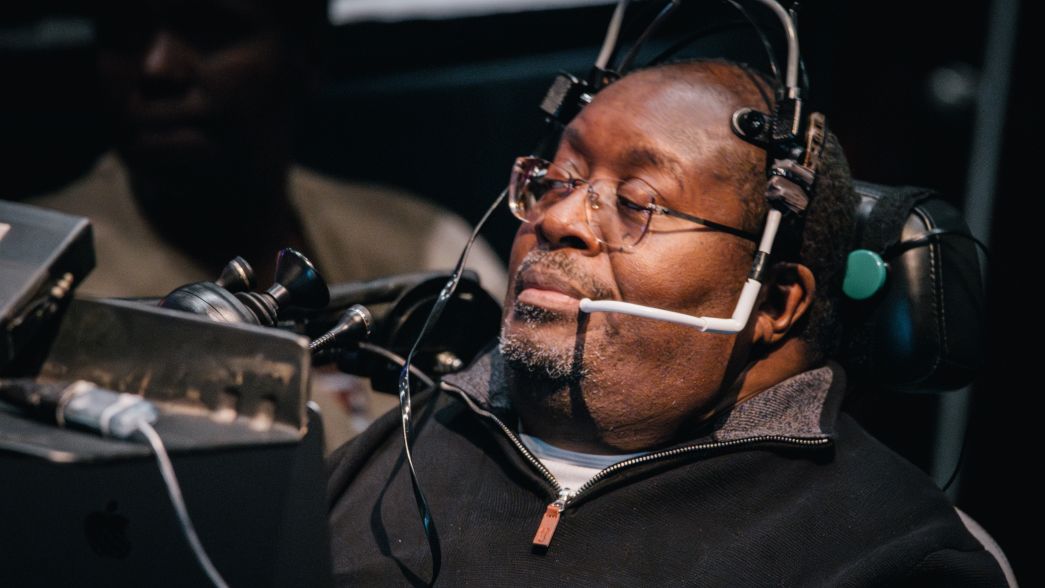
Clarence: There was a trombone player called John Kenny who was doing some projects around Europe with disabled children but wanted to find an opportunity to work with a disabled musician. His friend said: ‘Oh, have you not heard of Clarence Adoo? He has just had an accident, blah, blah, blah…’, and I didn’t have an instrument or anything, so he started asking around and chatted to Rolf Gehlhaar, who designs these electronic instruments and had in fact worked alongside (Karlheinz) Stockhausen. You couldn’t get a better person! He came to my house with John Kenny and we spoke about what to do, and then Rolf ended up staying behind asking me what movements I had – which is just control is my head – and so that was the starting point.
I would throw him a load of questions and then he would leave my house, light up a cigar, disappear for half an hour, come back, walk straight past me into the bedroom for a half an hour where my computer was, then come back and he would’ve solved those 20 questions. And then I would say, ‘Look Rolf, I want to play dynamics, I want to do this, I want to do that…’, and he would just disappear again. After about two days, he had some sort of working basic instrument.
So, I’ve got this headset on my head, it’s got a sensor on the top and two on the side, I’ve got my blow pipe, and the way he wrote the software was very versatile for me to move and slide. Now, there are sample sounds from all of the orchestra instruments, and all these sort of worldly sounds and drum kits and triggers and recordings. Because we have quite an eclectic group of instruments now, including my Headspace instrument, that even from the first chord we don’t know what the music is going to sound like exactly. It is a real voyage of discovery that we go through, so it’s really fascinating group to work with.
Q: Tell me about your concert on Tue 17 Mar at the RNCM as part of the inspirational Artists season?
Clarence: We’re coming with Candoco Dance Company, which is also a mixed group of performers with disabilities. That’s how our band started, because Candoco wanted to come and do a performance at The Glasshouse International Centre for Music in Gateshead, Newcastle (where RNS Moves is now based), and the music manager there called me for a chat about whether we could create a similarly representative orchestra. I now know a number of players that are incredible musicians that have mastered their instruments or an adaptive instrument. So, we started as a workshop warming up every session with the dancers and coming together to make a joint piece of art. After a week some audience members travelled from abroad to witness what we had created. That was the birth of RNS Moves.
My eyes were opened when I got catapulted into the disabled world. Paraorchestra was started by four of us that had disabilities, we met in London and decided to see if anybody else would like what we’re doing. (Founder member) Charles Hazelwood got us a half an hour gig in Brussels, and we played over there and got a standing ovation, and people came with television cameras and wanted to find out everything. The next opportunity was the 2012 Paralympics and we had the cheek to apply for an opportunity to play in the closing ceremony. Our second gig was playing to half a billion people! With Coldplay! We became well known in about six months and people wanted us to travel around the world.
Slowly after all these many years, there’s become a scene out there that people are finding out more and more about. And now young musicians living with a disability that started playing in school are banging on the doors of the ABRSM and all these examination places saying, ‘What do we do?’. We found out that things are possible, and a lot of these young people think it’s normal.
Q: You’ll be working with some of our students as part of the performance; for you, what is the importance of working with young musicians and providing opportunities to work with RNS Moves?
Clarence: I get so excited about an opportunity to set light to somebody’s imagination or talent in a different way, or to challenge them musically – and by how rich that experience can be. This instrument that I made, that I use, I woke up one day and said, ‘If I can play this, then maybe children can’, so we did it – we worked on a device, a simpler version, and what I get from seeing a young person who’s been sitting in a corner being told they can’t do anything to then being in a little group of people playing music is immeasurable.
I’m hoping that the students will be thinking in a different direction and learning things that they didn’t think were possible to do, in terms of achievements and just different ways of playing. There’s a lot of professional people out there who may not ever get near some of those ideas; incorporating improvising and different approaches to playing, it’s not something that they would normally get through the college or in a chamber band.
Q: Should classical music students be encouraged to look more broadly at the repertoire and ensembles out there and to embrace experimentation or improvisation?
Clarence: Definitely, and I say that with confidence because I see it often with our band. We have maybe five musicians from the Royal Northern Sinfonia and we are asking them to improvise in their own space and time. They feel this great satisfaction at gradually jumping those little hurdles.
Q: Do you think the Headspace could end up in common use by orchestras, or do you think that’s a long way off?
Clarence: I don’t think it’s a long way off because when I hear films and adverts and things like that, it’s a combination of electronic instruments and synthesizers and traditional orchestra instruments; mine is all thrown into one to make an instrument.
So, when I speak to a young composer and they ask me to teach them how to write for the Headspace instrument, I’ll say they need to learn how to write for electronics, try to think of as many descriptive words as you can for the sound you want the musician to make, play something close to that and see if the sound can be tweaked, or use a sample sound from nature or in the world. When our orchestra started, we used everything we could to shape these instruments – and look what’s available to us now.
Event Info
RNS Moves with Candoco Dance Company
Tue 17 Mar 2026, 8pm
RNCM Concert Hall
Photo credit: Tynesight Media
4 December 2025